
Skin tumors, expertise in Mohs Surgery
The fight against skin tumors requires not only early diagnosis but also precise surgical interventions, especially when the face area is affected. In this context, Dr. Hârceagă brings to Cluj-Napoca his expertise in the advanced treatment of skin cancer, using an internationally recognized method: Mohs surgery.
Skin tumors, especially basal cell and squamous cell carcinoma, are among the most common forms of cancer worldwide. Although many of them are treatable, their location in exposed areas – such as the face, nose, eyelids, or ears – requires interventions that completely remove the tumor tissue but also preserve as much healthy skin as possible. This is where Mohs surgery comes in, a high-precision micrographic technique that allows layer-by-layer excision of the tumor, with immediate microscopic examination during the operation.
Mohs surgery is considered the gold standard in the surgical treatment of skin cancers, especially when aesthetic and functional preservation of the affected region is essential. The major advantage of this technique lies in the very high cure rate and the reduction of the risk of recurrence, due to the direct control of the tumor margins during the intervention.
Dr. Hârceagă, a doctor with experience in treating skin tumors through Mohs surgery, offers this type of innovative treatment in Cluj-Napoca, offering patients the chance for a safe, aesthetic, and complete recovery.
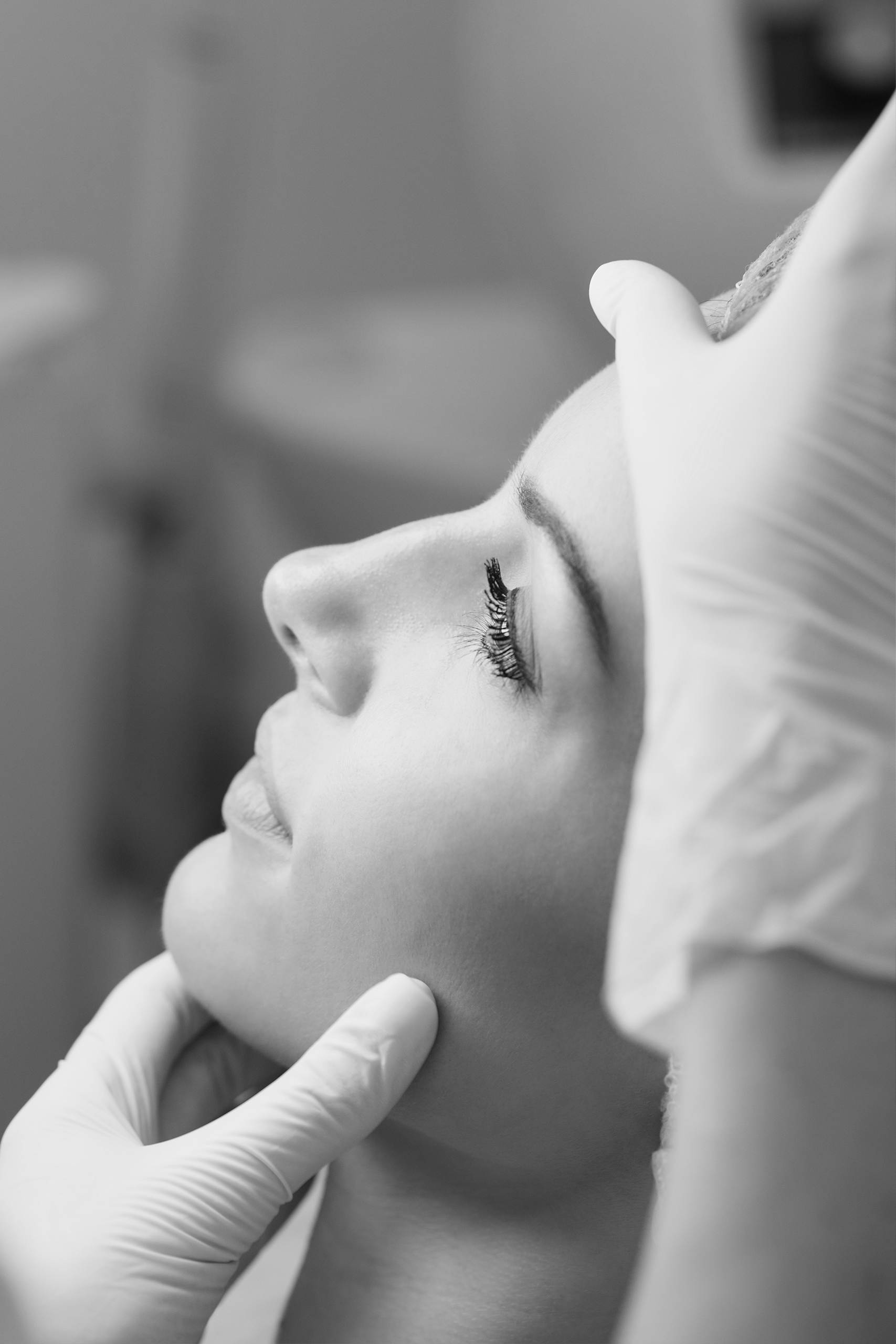
How is the operation performed using Mohs surgery?
Mohs surgery aims to completely excise the tumor with minimal sacrifice of healthy tissue. The operation is usually performed under local anesthesia and consists of several stages.
The initial excision of the tumor is done with minimal safety margins of approximately 2-3 mm. The tumor thus excised is sent on the same day to the pathology laboratory where a special technique is followed to examine the resection margins in their entirety.
Depending on the result of the examination of the margins in the laboratory, a new sample is excised if a certain segment is tumor-infiltrated. The examination in the laboratory is repeated for the new sample.
This work sequence is repeated until free tumor margins are ensured.
In most cases, two excisions are sufficient to achieve the objective of free tumor margins.
Usually, the operation is performed over the course of a day.
At the end, the area is reconstructed according to the principles of plastic surgery, trying to restore shape and function.
What is the cost of the operation using Mohs surgery?
The cost of a Mohs surgery operation starts from 1000 euros depending on the size of the treated tumor.
Surgical treatment of skin tumors
Surgical methods are the most frequently used for BCC treatment. Among the surgical techniques, we can mention: classical surgery without immediate verification of the margins of the excised piece, surgical excision with histopathological verification of the margins, and micrographic surgery or Mohs Surgery.
Advantages of Mohs micrographic surgical techniques
In the case of histopathological techniques, the tissue can be examined in a vertical, horizontal, or oblique plane. Traditional techniques involve examination in a vertical plane similar to a slice of bread. In micrographic surgery, examination in an oblique or horizontal plane is used (Fig.1). The advantage of this method is that it evaluates almost 100% of the margins of the piece. In standard histopathological evaluation (Fig.2), which performs vertical sections in paraffin or extemporaneously, less than 0.1% of the margin is evaluated. By evaluating the margins of the piece in their entirety, the risk of remaining unresected tumor is greatly reduced, consequently reducing the recurrence rate.
Dr. Olimpiu Hârceagă's Expertise in Mohs Surgery
Dr. Hârceagă conducted a doctoral study on the topic of Mohs Surgery, the topic of the doctoral thesis defended in June 2014 was “Comparison of clinical and histological margins for basal cell carcinomas of the face and neck using the micrographic surgery technique”. Dr. Hârceagă implemented Mohs micrographic surgery as a treatment method in the Dermatology Clinic Cluj-Napoca in 2013. It is the only hospital in the state system in Romania where patients can benefit free of charge from this type of treatment for non-melanocytic skin tumors.
In the literature, Mohs surgery has the lowest recurrence rates of 1-2% for BCC and almost double for SCC, for classical surgery the percentage approaches 10%. In addition to the advantage of very low recurrence, Mohs surgery has the major advantage of preserving healthy tissue, which is important in areas with important anatomical structures, especially at the level of the face.
Epidemiology of skin tumors
Malignant skin tumors are divided into two major classes: melanocytic (the most well-known is melanoma) and non-melanocytic (the most frequent in this category is basal cell carcinoma).
Non-melanocytic skin cancers are the most frequent malignant tumors in the Caucasian race. They represent 30%-40% of all neoplasms in Caucasians. For other races with darker skin, the incidence is much lower, thus reflecting the important role of ultraviolet (UV) radiation in the etiopathogenesis of this neoplasm.
Among NMSCs, the most frequent tumor is BCC, which represents about 75% of all cases in the U.S. The incidence of this tumor increases annually, doubling once every 14 years. Data on the incidence of this tumor appear to be underestimated because many of the lesions are treated without histological confirmation. Advanced age and male sex are associated with a higher risk of developing a BCC. More than 99% of patients with this type of tumor are white, and 95% of them are between 40 and 79 years old. Once a person develops a NMSC cancer, there is an increased risk of a new skin cancer appearing in the following years. The highest risk for a new skin cancer is for it to appear in the first year.
Basal cell carcinomas (BCC) are the most frequent skin cancers, constituting over 80% of all malignant skin tumors. If these tumors are discovered in the early stages, then the treatment can be limited to topical or non-invasive therapies: 5-fluorouracil (5-FU), radiotherapy (RT), electrocauterization, or mechanical curettage. For certain tumors that present aggressiveness characteristics, micrographic surgery can be used. However, the most frequent method of treatment remains surgery.
What is the price of breast lift surgery?
€3800
Mastopexy without implant
€5,500
Mastopexy with implant
The costs mentioned are estimates, and they may vary depending on the surgical technique chosen, the complexity of the case, as well as any additional procedures or investigations required.
A detailed final cost can only be established after a medical consultation, in which the patient’s clinical situation will be assessed and the individualized therapeutic plan will be established. These costs include: the surgeon’s and anesthesiologist’s fees, the period of hospitalization, all the medicines and materials needed during the surgery and during hospitalization. For a personalized estimate, we recommend scheduling a consultation.
