
Non-surgical facial rejuvenation with Morpheus8
Rejuvenation with Morpheus8 is a minimally invasive option for individuals seeking firmer skin with improved texture and a more defined facial contour, without the incisions and recovery period associated with surgical facelifts. The system combines microneedling with radiofrequency (RF) to deliver thermal energy to the medium-deep dermis, where the collagen and elastin network responsible for supporting the skin is located. By stimulating neocollagenesis and remodeling fibrous septa, Morpheus8 produces a discreet, natural “skin tightening” effect that builds progressively over 4–12 weeks and is maintained long-term when accompanied by a proper skincare routine.

What is Morpheus8?
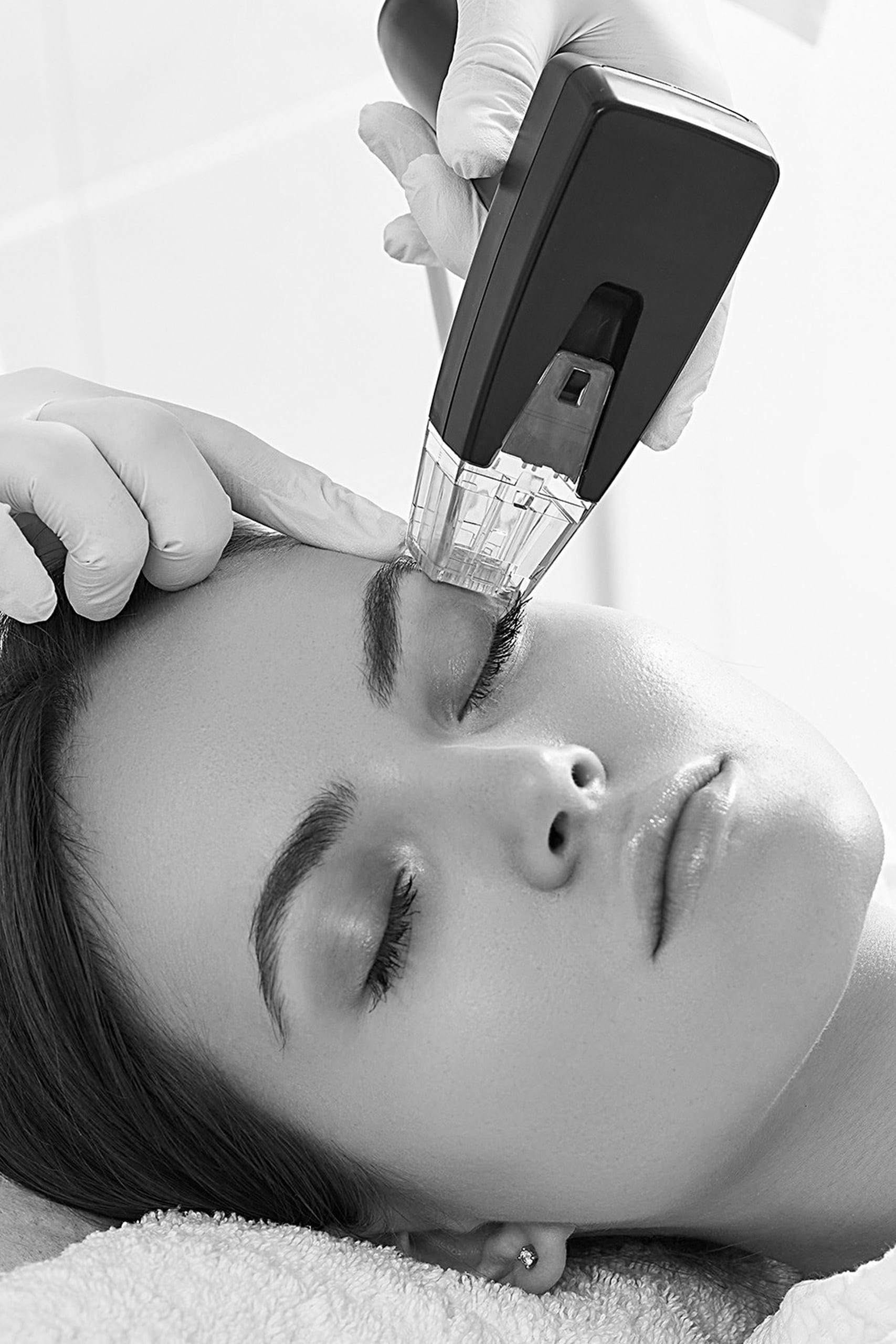
Morpheus8 is a radiofrequency microneedling treatment designed to act deep within the dermis through fine microneedles that penetrate in a controlled manner at different depths. During each “pass,” the tip of the needles releases RF energy, generating uniform heating of the target tissue. This controlled heat contracts existing collagen and activates fibroblasts, stimulating the production of new collagen and elastin. The result is denser and more elastic skin, finer texture, and clearer definition of areas where skin laxity “blurs” the contour (jawline, submental area, cheeks).
01. What are the benefits of the Morpheus8 procedure?
The effects sought with Morpheus8 are visible on two complementary levels. On the surface, pores appear smaller, fine lines fade, and texture irregularities and post-acne scars become less evident. Deep down, firmness increases with the synthesis of new collagen, and the skin “sits” better on the support structures, which produces a discreet and natural lift in the lower third of the face. The jawline becomes clearer, the area under the chin gains a firmer appearance, and the entire face appears rested and coherent, without artificial effects. All these changes occur gradually, with a reduced recovery time, so that current activities can be resumed quickly, respecting a few simple care recommendations.
02. How does Morpheus8 work?
The device delivers RF energy through microneedles at depths selected according to the objectives and the treated area. The heat released in the medium-deep dermis causes immediate contraction of collagen fibers and initiates tissue repair processes: fibro-septa (the connective network that supports the skin) is remodeled, neocollagenesis is stimulated and, secondarily, elastin neosynthesis. This structural remodeling explains both the “tightening” of the tissue (skin tightening) and the progressive smoothing of surface irregularities. For each region, the doctor adjusts the depth and energy, can perform passes at multiple levels, and can fragment the treatment into micro-zones to obtain a uniform and natural result.
03. What are the indications for the Morpheus8 procedure?
Morpheus8 is recommended for patients with mild to moderate laxity in the cheeks, jawline, and neck, those who notice fine lines, dilated pores, or a “crepey” appearance of the skin, as well as people with acne scars and uneven texture. It is also useful when the skin is thinned after weight loss or after pregnancy, including on certain body areas. It is not a substitute for surgical lifting in cases with advanced laxity, but it excellently covers the space between medical skincare and surgical interventions, offering a solution with short recovery and cumulative effects.
04. What areas can be treated?
The treatment can be performed on the entire face or targeted on regions such as the cheeks, forehead, temples, jawline, and submental area. The neck and décolletage respond well to protocols in multiple passes with energies adapted for the thinner tissue. Selectively, Morpheus8 can be applied to the abdomen (especially post-pregnancy, for fine skin with mild laxity) and on the arms, where the “crepey” texture betrays the loss of tone. The choice of areas and depths is made after clinical evaluation, so that the result is harmonious, without differences between adjacent regions.
05. What does a session involve?
The process begins with a consultation, in which the objectives, priority areas, and indicative parameters are established. On the day of the procedure, topical anesthesia (cream) is applied for 30–45 minutes, intended to reduce the discomfort associated with pricks and the heat felt. The skin is thoroughly cleaned, and the doctor performs the treatment in ordered series, adjusting the depth of penetration and RF energy according to the thickness of the tissue, the sensitivity of the area, and the desired objective. A session lasts, on average, 20–45 minutes, depending on the number of areas and the number of passes required. At the end, soothing products with a repairing role and a barrier cream are applied; photoprotection is mandatory in the following weeks. The sensation during the procedure is usually described as a succession of pricks followed by local heat; with adequate topical anesthesia, most patients tolerate the treatment very well.
06. How many sessions are needed?
The usual protocol includes 2–3 sessions at intervals of 4–6 weeks, depending on the degree of laxity and the objectives established. The first changes become visible in 2–4 weeks, as the transient edema recedes and the existing collagen contracts; the maximum effect takes shape between 8 and 12 weeks after the last session, when neocollagenesis has progressed enough to support firmness. For maintenance, an annual session is recommended, with adjustment of the parameters to the natural evolution of the skin and to the lifestyle. In combined protocols (for example, alongside botulinum toxin, biostimulators, or medical skincare), correct sequencing maximizes results and shortens the total time to the objective.
07. How to prepare for the procedure?
The preparation aims to minimize risks and optimize the skin’s response. It is recommended to discontinue topical retinoids, AHA/BHA acids, and other irritating procedures 5–7 days before. Avoid sun exposure, tanning beds, and self-tanner for 7–10 days pre-treatment; tanned or recently exposed skin increases the risk of post-inflammatory hyperpigmentation. Notify the doctor about anticoagulants or supplements such as omega-3, ginkgo, or vitamin E, which may promote bruising; it will be decided individually whether adjustment is necessary. On the day of treatment, come with clean skin, without makeup or creams. If you have a history of post-inflammatory hyperpigmentation, you will receive a photoprotection and antioxidant plan adapted to the phototype.
08. What to expect after the procedure?
Post-procedure, the skin is slightly red for 24–72 hours, and a discreet edema may appear for 1–3 days; sometimes, punctiform micro-crusts form for 2–5 days, a sign of healing on the surface. Avoid makeup in the first 24 hours; subsequently, use non-comedogenic and gentle products. Apply SPF 50 daily and limit sun exposure for at least two weeks. It is recommended to avoid sauna, swimming, and very intense workouts for 48–72 hours, as well as resuming retinoids/acids only after 5–7 days, when the skin barrier has recovered. The results build progressively: as the new collagen organizes, the skin becomes firmer, and the texture refines.
09. What are the possible side effects?
The most common reactions are erythema, edema, and a sensation of mild burning, all transient. Small bruises or punctiform crusts may appear, which resolve on their own with gentle care. In darker phototypes, the risk of post-inflammatory hyperpigmentation is higher; therefore, rigorous photoprotection and personalized settings are essential for prevention. Serious complications are rare when protocols are followed: superficially, mild burns or, very rarely, infection or milia may be observed. Close communication with the doctor, compliance with the indications, and returning for check-ups further reduce these risks.
Main contraindications
Treatment is not recommended during pregnancy or breastfeeding (relative contraindication), on areas with active skin infections or active herpes. Major coagulation disorders or unadjusted anticoagulation require caution; likewise, the presence of implants or electronic devices in the treatment area requires individual evaluation. The marked tendency to hypertrophic/keloid scarring is carefully analyzed, and the decision is made personalized, depending on history and alternatives.
Why choose Morpheus8?
The treatment plan is personalized in detail: the depths, number of passes, and energy are established according to phototype, tissue thickness, objectives, and tolerance. The approach is built for safety on all phototypes, with an emphasis on preventing post-inflammatory hyperpigmentation through correct selection of parameters and consistent photoprotection.
Morpheus8 is integrated when useful in combined protocols — from botulinum toxin for dynamic lines, to biostimulators or medical skincare for maintenance — so that each intervention contributes coherently to the result.
You will receive clear recovery recommendations from Dr. Olimpiu Hârceagă, as well as post-procedure check-ups to monitor progress and adjust the plan, if necessary.

What is the cost of non-surgical facial rejuvenation with Morpheus8?
200 - 300 RON
Initial consultation
1500 - 2200 RON
Full session for face
2300 – 3200 RON
Full session for face and neck
4200 – 6000 RON
Packages of 4 sessions
The mentioned costs are estimates and may vary depending on case complexity, as well as any additional procedures or investigations required.
The final price depends on the extent of the area, the number of passes and depths used, as well as any combinations with other treatments. In the current offer, with the purchase of a package, the consultation becomes free, so that the course is both efficient and accessible.
Targeted areas (cheeks, jawline, submental) start, depending on the surface and parameters, from 1,200 to 1,800 lei per session.
A detailed final cost can only be determined after a medical consultation, during which the clinical situation will be evaluated and an individualized treatment plan will be established. For a personalized estimate, we recommend scheduling a consultation.
